A luxury villa can require hundreds of individual products before it is ready for handover. Flooring, doors, windows, sanitary ware, kitchen cabinets, wardrobes, lighting, customized furniture and decorative materials all need to work together within one design.
This is why procurement for a luxury villa should not be treated as a series of separate purchases.
The most successful projects usually begin with a clear design direction, accurate drawings, product specifications and a purchasing plan that connects every category to the construction schedule.
If you are planning to source building materials and furniture from China, preparing these elements before purchasing can make the entire process significantly more efficient.
1. Start with the Design Before Selecting Products
One of the most common mistakes in villa procurement is selecting products too early.
A beautiful tile, door or sofa may look perfect in a showroom, but that does not necessarily mean it is suitable for your project.
Before major purchasing decisions are made, the villa should have a reasonably clear interior design direction.
The design helps determine the relationship between materials, colors, dimensions and furniture. It also allows different product categories to be considered as part of one complete space rather than as isolated items.
For example, the flooring affects the door finish. The wall material affects the lighting. The bathroom layout determines sanitary ware dimensions. The kitchen layout determines cabinet dimensions and appliance positions.
For a luxury villa, these relationships become even more important because customization is often involved.
At VIGOHOME, we therefore recommend developing the design and procurement plan together rather than waiting until construction is almost complete before starting product selection.
2. Prepare Your Floor Plans and Project Drawings
Floor plans are one of the most important documents when preparing a villa procurement plan.
They allow the project team and suppliers to understand the actual size and structure of the property.
For customized products such as kitchens, wardrobes, doors, windows and bathroom cabinets, dimensions directly affect whether a product can be manufactured and installed correctly.
Ideally, the information available before procurement should include floor plans, architectural drawings, CAD files, elevations, renderings and relevant site measurements.
If the project is already under construction, recent site photos and videos are also useful.
The more accurate the project information is, the easier it becomes to prepare quantities, specifications and preliminary solutions before purchasing begins.
3. Divide the Project into Product Systems
Instead of purchasing one product at a time, it is more efficient to divide the villa into several major procurement systems.
For example, a complete villa may involve architectural doors and windows, wall and floor finishes, kitchen systems, bathroom systems, customized cabinetry, lighting, furniture, curtains and other decorative products.
Thinking in systems makes it easier to identify missing items and understand which products need to coordinate with each other.
It also helps establish a logical procurement sequence.
Doors and windows, for example, usually need to be confirmed much earlier than loose furniture because they involve production dimensions and installation requirements.
Customized cabinets also require accurate measurements and coordination with electrical and plumbing locations.
Furniture, on the other hand, can normally be finalized later once the interior dimensions and overall style are clear.
4. Build a Preliminary BOQ and Purchasing List
Once the design and product systems are clear, the next step is to create a preliminary purchasing list or BOQ.
This does not need to contain every final model immediately.
Its purpose is to establish the overall scope of procurement.
A good preliminary list should identify the product category, approximate quantity, dimensions where applicable, preferred materials, design requirements and any special technical requirements.
This gives the project team a much clearer picture of what needs to be sourced.
It also makes budget discussions more meaningful.
Instead of asking, “How much will the materials for my villa cost?”, the project can be broken down into specific categories and specifications that can actually be evaluated.
5. Set the Budget by Category, Not Only by Total Project Cost
For luxury villa projects, having an overall budget is useful, but it is usually not enough.
The budget should gradually be divided between major product categories.
Some clients may prioritize premium natural stone and customized furniture. Others may allocate more of the budget to kitchens, bathrooms, windows or smart-home systems.
There is no single correct allocation.
What matters is understanding where the project requires premium specifications and where alternative materials can achieve the desired appearance without unnecessary cost.
This is where working from the design becomes particularly valuable.
The goal is not simply to find the cheapest individual product. The goal is to achieve the right balance between design, quality, performance and total project cost.
6. Confirm Specifications Before Comparing Prices
Price comparisons are only meaningful when the specifications are comparable.
Two products that look similar in photographs can have very different materials, internal structures, hardware, finishes and performance standards.
This is particularly important for products such as windows, doors, cabinets, sanitary ware and customized furniture.
For example, when comparing an aluminum window system, the glass configuration, aluminum profile, wall thickness, hardware, surface treatment and opening system can all affect the final price.
The same principle applies to furniture.
Material structure, foam density, fabric or leather grade, internal framing and finishing details can create significant differences between products that initially appear similar.
For project procurement, specifications should therefore be confirmed before final price comparisons are made.
7. Coordinate Customized Products with the Construction Schedule
Customized products require more planning than ready-made products.
Kitchen cabinets, wardrobes, doors, windows, bathroom cabinets and built-in furniture normally require measurements, shop drawings, production approval and manufacturing time.
They also need to arrive at the correct stage of construction.
Ordering too late can delay installation.
Ordering too early can create storage problems or increase the risk of damage on site.
A procurement schedule should therefore be connected to the construction schedule.
This allows the project team to determine when measurements need to be confirmed, when production should begin, when quality inspections should take place and when each shipment should leave China.
8. Plan Quality Control Before Shipping
For international projects, quality control should happen before the products are shipped—not after they arrive at the destination.
This becomes particularly important when one project contains many customized products.
Dimensions, colors, quantities, accessories, packaging and product specifications should be checked against the approved order information.
For certain products, trial assembly or factory inspection may also be appropriate.
Professional packaging is another important part of the process.
Building materials and furniture may travel thousands of kilometers by sea and then continue by road before reaching the project site. Packaging should therefore be considered according to the product type and transportation conditions.
Solving a problem before loading is usually much easier than discovering it after the container arrives at the project.
9. Consolidate Products into a Coordinated Shipping Plan
When products come from multiple categories, logistics becomes part of procurement planning.
Different products have different production times, packaging requirements and installation priorities.
Without coordination, a project can end up with many small shipments arriving at different times, increasing freight costs and creating additional work for the client.
A coordinated procurement approach makes it possible to plan production and consolidation more efficiently.
Products can be grouped according to project stage, container utilization and delivery requirements.
For overseas villa projects, this can significantly simplify communication compared with managing every product category independently.
10. Consider a One-Stop Project Solution
Managing dozens of separate suppliers may appear flexible at the beginning, but it can create considerable coordination work as the project develops.
Every supplier has different drawings, production schedules, payment arrangements, quality standards and shipping requirements.
For a complete villa, these relationships can quickly become complicated.
A one-stop project solution takes a different approach.
Instead of focusing only on selling individual products, the project is considered as a complete system—from design and material selection to customized production, quality control, consolidation and delivery.
At VIGOHOME, we work with international villa, hotel, apartment and commercial projects that require multiple building-material and furniture categories.
Our project team can work from floor plans, drawings, design references and project requirements to help develop an integrated procurement solution.
For clients visiting China, this also means that product selection can be prepared before the sourcing trip begins rather than starting from zero after arrival.
Visit VIGOHOME in Foshan
If you are planning to visit China for your villa project, preparation can make a major difference to the efficiency of your trip.
Before your visit, send your floor plans, project drawings, current construction progress, design references and preliminary requirements to the project team.
This allows the team to review the project in advance and prepare relevant product categories and solutions for discussion.
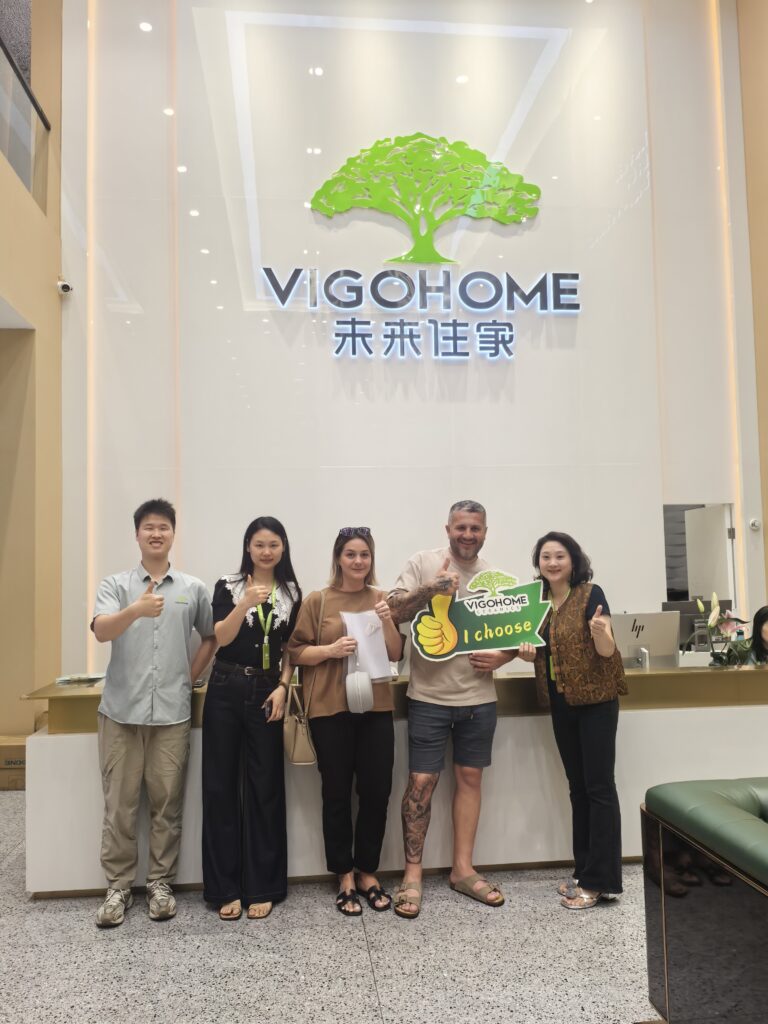
At VIGOHOME in Foshan, clients can explore building materials, customized products and furniture across our large showroom network while discussing their project with the design and project teams.
For a luxury villa, the objective should not simply be to purchase more products.
It should be to create a coordinated solution in which the design, materials, furniture, budget, production and delivery all work together.